
Language
Views: 0 Author: Site Editor Publish Time: 2026-07-06 Origin: Site


Near-peer adversaries and complex operational environments demand absolute optical superiority. Modern troops require distinct advantages in zero-light conditions. Without this capability, combat elements risk critical exposure and catastrophic mission failure. Procurement teams face a difficult challenge here. They must balance unit acquisition costs against essential tactical advantages. These advantages include target identification ranges, operator fatigue mitigation, and raw system durability.
We created this article to help you navigate these choices. It provides an objective, spec-based framework. You will learn how to evaluate and shortlist current systems effectively. We will guide military and law enforcement professionals through acquiring the exact gear they need. Our breakdown translates complex technical data sheets into real-world tactical outcomes. You will discover exactly what separates acceptable gear from truly exceptional equipment. Procurement officers cannot afford to make decisions based purely on marketing brochures. They need actionable data. We focus purely on the technical realities governing modern night operations.
Gen 3 tubes are primarily differentiated by filming technology (Thin-Filmed vs. Unfilmed), which directly impacts low-light performance and unit cost.
Figure of Merit (FOM) is a baseline, but Signal-to-Noise Ratio (SNR) and Halo values are the true predictors of tactical effectiveness in dynamic lighting.
Transitioning to White Phosphor Technology (WPT) reduces operator eye strain during prolonged deployments compared to legacy green phosphor.
Procurement must strictly align with Omnibus (Omni) classifications and ITAR compliance to ensure reliable supply chains and MIL-SPEC durability.
Legacy systems fail to provide sufficient target discrimination. Gen 2+ or early Gen 3 platforms struggle in extreme low-light scenarios. Level 4 darkness typically renders them useless without active IR illumination. Relying on active IR compromises operator stealth immediately. Adversaries easily detect IR signatures, turning a tactical advantage into a lethal liability. You need systems capable of passive target identification. We define success as passive recognition at distances exceeding 200 meters.
Operators also need seamless transitions between pitch-black rural areas and brightly lit urban environments. Autogating technology handles these rapid lighting shifts. The power supply rapidly toggles voltage to protect the tube. It preserves uncompromised peripheral awareness during dynamic entries. The primary distinction of modern gear lies in the core hardware. A Gallium Arsenide (GaAs) photocathode paired with an ion barrier film defines the non-negotiable standard. These elements empower modern night vision goggles. They amplify ambient light exponentially better than legacy alternatives. Operating without them in modern theaters invites unacceptable risk.
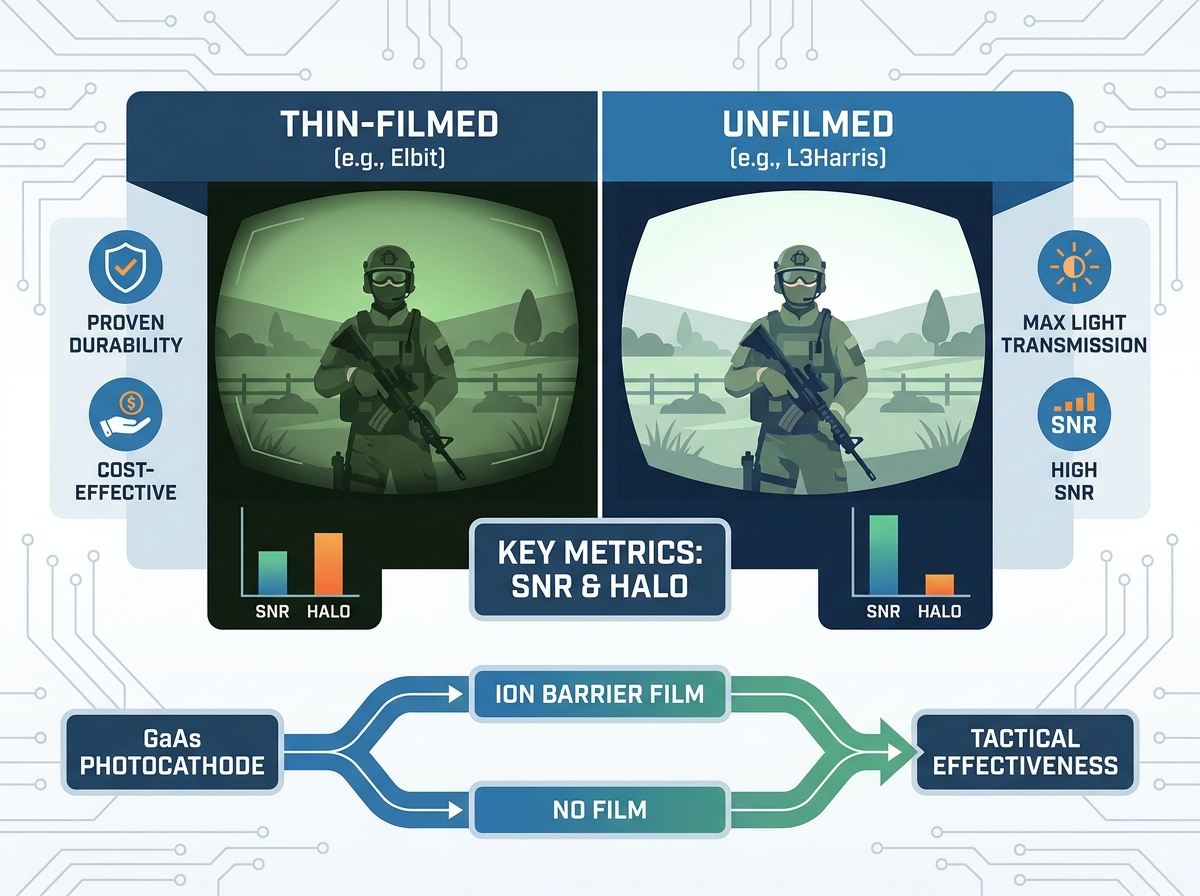
You must choose between thin-filmed and unfilmed technologies. Each category serves distinct operational needs. Vendors like Elbit Systems champion thin-filmed options. We evaluate these through a practical lens. They offer a lower acquisition cost and highly proven durability. They deliver excellent performance in 90% of tactical environments. However, you must accept a transparent assumption. Thin-filmed units suffer a marginal loss of light transmission. The ion barrier film slightly impedes the flow of electrons. This reduction roughly equals 10-15% compared to unfilmed counterparts. Operators only notice this deficit in ultra-low-light rural environments. Starless nights and heavy cloud cover expose this limitation.
Conversely, unfilmed variants from manufacturers like L3Harris remove the ion barrier completely. This removal allows maximum light transmission. It yields the highest possible Signal-to-Noise Ratio (SNR). These units excel in subterranean or deep-canopy environments. The implementation risk here involves budget constraints. Unfilmed hardware carries a significant price premium per unit. Procurement officers require careful budget justification. They typically reserve these units for Tier 1 or Special Operations mission sets. Conventional forces often deploy thin-filmed variants perfectly well.
Below is a breakdown comparing the two primary technical approaches. We built this to streamline vendor evaluations.
Feature | Thin-Filmed Gen 3 | Unfilmed Gen 3 |
|---|---|---|
Light Transmission | Standard (10-15% reduction) | Maximum available |
Ideal Environment | Urban, mixed lighting, standard rural | Subterranean, deep canopy, ultra-low light |
Acquisition Cost | Moderate (highly scalable) | Premium (requires budget justification) |
Target User | Conventional forces, law enforcement | Tier 1, Special Operations units |
Reading a data sheet requires understanding tactical translations. An image intensifier tube features several critical metrics. You must weigh them according to actual field impact. High numbers do not always equal better operational gear.
Signal-to-Noise Ratio (SNR): This remains the primary driver of image clarity in dark environments. High SNR means less visual static. Scintillation obscures target details during critical moments. A minimum SNR of 30+ is increasingly the standard for front-line military deployments. It guarantees crisp visuals when ambient light vanishes completely.
Resolution (lp/mm): Line pairs per millimeter dictate image sharpness. Once resolution hits 64-72 lp/mm, higher numbers yield diminishing returns. The human eye cannot process finer details without additional magnification. Chasing an 81 lp/mm resolution often wastes budget dollars.
Figure of Merit (FOM): You calculate this by multiplying Resolution and SNR. It serves as an export and procurement baseline. A FOM of 2000+ indicates high quality. However, warn your team against relying on FOM alone. A disproportionately low SNR can hide behind a massive resolution number. This creates a highly flawed image disguised by a great FOM score.
Halo Limits: This metric proves critical for urban operations. Smaller Halo specifications (under 0.8mm) prevent streetlights or muzzle flashes from blinding the operator. Large halos wash out the surrounding area. Tight halo values maintain the operator's field of view during chaotic firefights inside buildings.
The science of White Phosphor Technology (WPT) fundamentally changes operator ergonomics. White phosphor activates rod receptors in the human eye more naturally than green. It produces an image boasting higher perceived contrast. Operators report vastly improved depth perception. This biological alignment translates directly into combat effectiveness. You identify uneven terrain much faster.
Fatigue reduction remains a massive implementation reality. Prolonged use of legacy green phosphor leads to severe eye fatigue. Operators frequently suffer from "green splash" headaches after extended missions. WPT allows much longer operational durations. Personnel maintain peak cognitive performance without visual degradation. They process threats faster and navigate complex terrain safer. We cannot understate the value of operator comfort during eight-hour night patrols.
We must also balance cost versus benefit. WPT is undeniably the current military standard. Everyone wants the crisp, greyscale image. However, high-spec green phosphor tubes can still serve effectively. Budget-constrained reserve units often utilize them. Training elements also benefit from these lower-cost alternatives. Green phosphor still amplifies light exceptionally well. It simply lacks the ergonomic advantages required for multi-hour, direct-action deployments. You must decide if the ergonomic upgrade justifies the fiscal leap for non-combat elements.
Commercial-grade Gen 3 tubes are strictly unsuitable for military use. Procurement teams must verify Omni classifications. Tubes must meet specific Omnibus contract standards, such as Omni VIII. These strict criteria dictate recoil resistance, drop testing, and temperature extremes. You cannot compromise on MIL-SPEC durability. Commercial units fail rapidly under physical stress. Reliable gear ensures operators survive harsh combat realities.
Cross-platform integration introduces another layer of complexity. You might consider mounting the same core architecture inside a dedicated weapon-mounted night vision scope versus helmet-mounted binocular systems. Recoil ratings become a primary failure point here. Weapon-mounted systems require aggressive shock mitigation. If incorrectly specified, the recoil impulse will shatter the internal components. Goggle-rated tubes rarely survive prolonged rifle recoil. Procurement officers must isolate dedicated weapon sight requirements from standard helmet applications.
Lifespan and degradation metrics also dictate long-term planning. Gen 3 tubes boast a 10,000+ hour operational lifespan. You must frame this across a 5-10 year deployment cycle. Planners need to account for routine housing maintenance. Systems require regular nitrogen purging to prevent internal fogging. O-rings degrade over time. These logistical steps ensure peak performance remains intact across a decade of hard use. Proper maintenance protocols keep your fleet mission-ready. Discarding tubes early due to housing failures wastes enormous amounts of capital.
Structuring your procurement process prevents costly acquisition mistakes. We recommend a strict logical framework to filter out lower-tier vendors. Follow these steps to secure the right night vision goggles for your specific unit. Flawed purchasing logic leaves troops vulnerable.
Step 1: Define the Operational Environment: Assess where your teams deploy most frequently. Urban settings prioritize autogating features and extremely low Halo limits. Deep rural or subterranean missions prioritize unfilmed technology and the highest possible SNR. Do not buy jungle gear for a desert fight.
Step 2: Establish Minimum Thresholds: Set hard limits for critical metrics. Demand a FOM of 2200+ for frontline assault elements. Support units can operate effectively at 1800 FOM. Lock in your desired Halo and SNR minimums early in the solicitation process. Disqualify any vendor falling below these lines.
Step 3: Request Testing Data: Never buy blind. Require vendors to supply standard tube data sheets (TDS) for every single unit. You must review this data before finalizing purchase orders. This ensures absolute batch consistency across your entire fleet. Accept no substitutes or bulk averages.
Actionable Next Step: Initiate a limited testing rollout. Enter an evaluation phase using 5-10 units of both thin-filmed and unfilmed variants. Let operators test them rigorously before committing to fleet-wide adoption. Field feedback outweighs theoretical data sheets every single time.
Evaluating Gen 3 tubes is an exercise in balancing capabilities. You must weigh the absolute performance of Unfilmed WPT against the practical scalability of Thin-Filmed alternatives. Budget constraints always compete against the desire for ultimate optical superiority.
We must reiterate a critical truth. Specifications on a data sheet only matter as much as they improve survivability and lethality in the field. Procurement is not about chasing the highest numbers. It is about equipping operators for specific environmental challenges.
Always align tube specifications with your primary mission environment.
Prioritize high SNR and low Halo values over chasing maximum resolution.
Demand comprehensive tube data sheets to verify vendor batch consistency.
Conduct localized field testing before executing massive fleet-wide purchases.
A: Gen 3 systems utilize a Gallium Arsenide (GaAs) photocathode, which vastly increases light sensitivity compared to Gen 2+ multi-alkali photocathodes. Gen 3 tubes also feature an ion barrier film. This film protects the photocathode from positive ion degradation, significantly extending the usable lifespan to over 10,000 hours.
A: Historically, early unfilmed tubes were considered more fragile. However, current unfilmed tubes pass the exact same rigorous MIL-SPEC shock and drop testing as thin-filmed variants. Modern manufacturing advancements have eliminated the durability gap, making them highly reliable for front-line combat deployments.
A: A realistic range for modern military applications sits between 1800 and 2400+ FOM. Support units typically utilize 1800 FOM, while frontline assault elements demand 2200+. High-FOM devices are strictly regulated by ITAR export restrictions, meaning international procurement requires specific US Department of State authorization.
A: Weapon-mounting standard goggle tubes carries extreme risks. Helmet-mounted tubes often lack the specialized shock mitigation required to survive heavy weapon recoil. Without a proper recoil-rated housing, the kinetic impulse will destroy the tube. Always ensure the device is explicitly rated for the caliber you intend to fire.


