
Language
Views: 0 Author: Site Editor Publish Time: 2026-07-07 Origin: Site


Operational reality dictates harsh conditions for modern security professionals. Threats never pause for complex lighting. They exploit heavy foliage and total darkness aggressively. Your response time dictates mission success directly. Relying solely on traditional Image Intensification (I2) leaves dangerous tactical gaps. Standalone thermal imaging detects body heat effectively. It cannot, however, read license plates or identify facial features accurately. Standard I2 fails entirely in heavy smoke. It struggles immensely in environments possessing zero ambient light.
Modern operators require versatile optical solutions. We introduce the multispectral fusion night vision binocular. It serves as the definitive tool for overcoming legacy limitations. It merges distinct sensor inputs seamlessly. You gain unparalleled situational awareness instantly.
This article presents a highly technical evaluation guide. It assists procurement officers and tactical commanders directly. You will learn to evaluate specifications objectively. We guide you toward optimal operational deployment. Discover how to equip your elite security forces effectively.
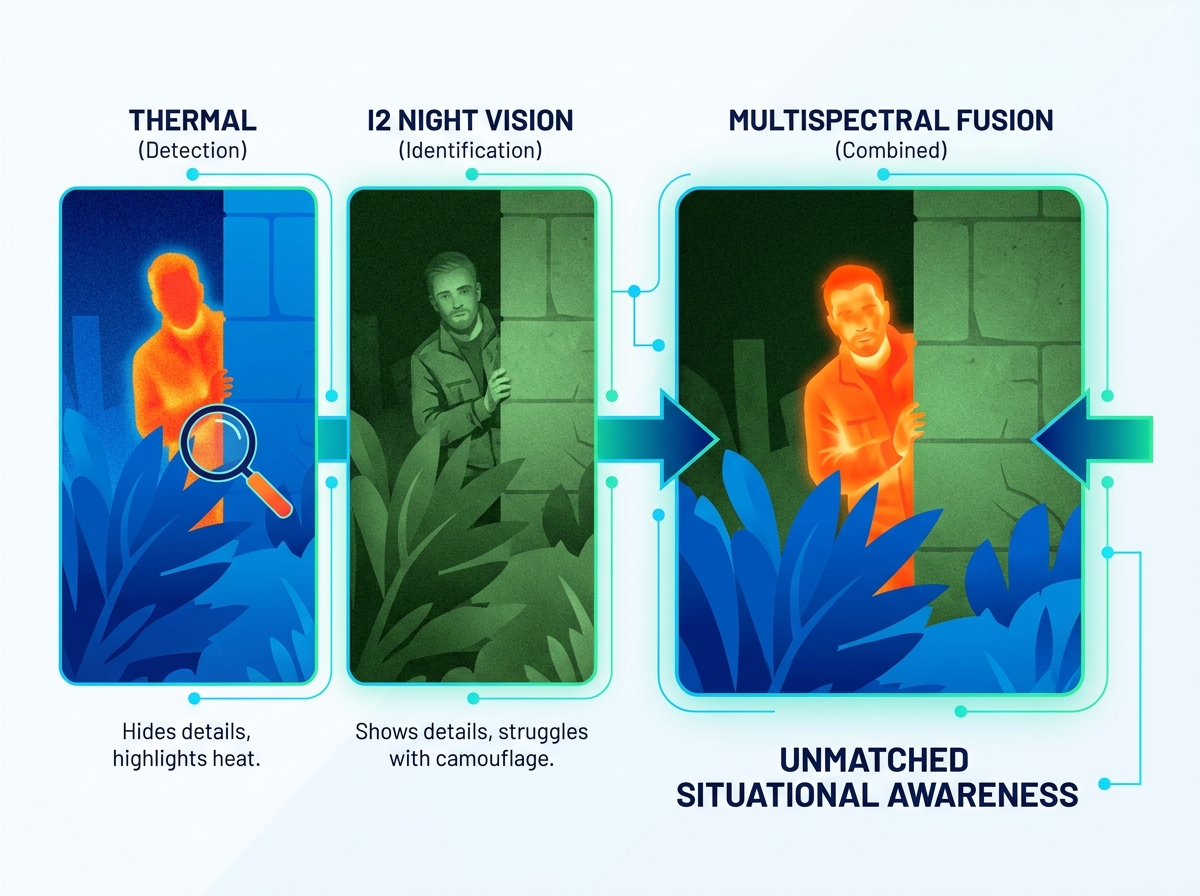
Unmatched Situational Awareness: Merging thermal and I2 sensors provides rapid target detection (thermal) alongside positive target identification (I2).
Critical Trade-offs: Thermal fusion binoculars deliver superior performance but require strict evaluation of weight, latency, and power consumption.
Form Factor Matters: Distinguish between true binoculars (dual distinct channels) and bioculars (single objective lens split to two eyes) for depth perception needs.
Mission-Driven Procurement: Selection must align with specific security protocols (perimeter defense vs. dynamic tactical response).
Security teams operate in highly chaotic environments. They need immediate visual clarity constantly. Modern night vision fusion solves visibility issues directly. It overlays thermal heat signatures onto enhanced ambient light images. The internal processor merges these distinct feeds in real-time. You observe a unified, comprehensive picture. This merged view highlights warm objects vividly. It places them against a highly detailed optical background. Modern devices allow users to adjust the fusion ratio manually. You can prioritize the thermal overlay during heavy fog. You can favor the I2 tube during clear, moonlit nights. This adaptability ensures constant visual dominance.
Security forces understand the crucial difference between detecting and identifying. Thermal sensors detect concealed threats instantly. A suspect hiding in dense brush glows brightly on the screen. Thermal energy cuts through foliage effortlessly. However, thermal displays lack fine optical details. They cannot show you a suspect's exact facial features. They cannot distinguish a lethal weapon from a benign tool easily. Standard NVG identifies these crucial details. It uses ambient light to render physical textures. Fusion technology does both simultaneously. You detect the heat signature early. You then instantly identify the subject using the optical overlay. This prevents tragic friendly fire incidents. It ensures lawful engagements based on positive identification.
Adversaries employ advanced camouflage techniques frequently. They deploy smoke grenades to cover their movements. They exploit sudden bright lights to blind standard optics. These tactics defeat standard night vision easily. Multispectral fusion renders these common countermeasures completely ineffective. The thermal channel cuts right through dense smoke. It penetrates fog and dust clouds seamlessly. If a sudden bright light washes out the I2 tube, you do not go blind. The thermal sensor continues tracking movement uninterrupted. You maintain continuous situational awareness regardless of environmental interference.
Total darkness completely cripples standard I2 systems. Image intensifiers require ambient starlight or moonlight. In sealed buildings, they fail entirely. Subterranean levels render them completely useless. Operators must activate an infrared (IR) illuminator to see. This IR beam acts like a massive flashlight in the infrared spectrum. Other night vision devices see this beam instantly. It reveals your exact position to adversaries. A thermal fusion binocular needs zero ambient light. The thermal sensor operates flawlessly in zero lux conditions. You remain completely covert while navigating pitch-black environments.
Thermal imaging carries strict physical limitations independently. It cannot see through standard glass. A thermal sensor only reads the surface temperature of a windowpane. It cannot look inside a target vehicle. It cannot read text, street signage, or license plates. This creates massive blind spots during urban operations. Multispectral fusion solves this major flaw directly. It utilizes the I2 channel to capture necessary optical details. You can scan a vehicle's heat signature from afar. You can simultaneously read its license plate through the optical channel. This dual capability proves mandatory for modern law enforcement operations.
Procurement teams must clarify technical hardware differences early. The form factor dictates tactical viability entirely. Avoid common purchasing mistakes by understanding sensor configurations.
Binoculars: These feature dual sensors and dual optical tubes. They provide true stereoscopic vision constantly. You gain critical depth perception. This allows you to judge distances accurately. Depth perception proves mandatory for driving vehicles. It remains essential for running or navigating complex stairwells safely.
Bioculars: These utilize a single objective lens only. The internal device splits one image into two separate eyepieces. They cost considerably less to manufacture. They reduce overall helmet weight effectively. However, they offer exceptionally poor depth perception. The user sees a flat, two-dimensional image. They remain completely unsuitable for dynamic tactical movement.
Choosing the right device requires analyzing specific sensor metrics. Spec sheets often confuse buyers initially. Focus exclusively on the data dictating field performance. Thermal cores rely heavily on NETD (Noise Equivalent Temperature Difference). Look for an NETD below 40mK for high sensitivity. Resolution matters greatly. A 640x480 thermal core outperforms older 384x288 models significantly. Digital and analog NV require extremely high low-light sensitivity. Assess the frame rate carefully before purchasing.
Sensor Component | Key Metric | Baseline Target Specification | Tactical Impact |
|---|---|---|---|
Thermal Core | NETD | <40mK | Higher sensitivity detects smaller temperature shifts rapidly. |
Thermal Resolution | Pixel Array | 640x480 | Improves target clarity at extended engagement distances. |
Image Intensifier | Figure of Merit (FOM) | 1800+ | Determines low-light resolution and signal clarity accurately. |
Digital Display | Refresh Rate | 60Hz | Prevents image blurring during rapid physical movement. |
Digital fusion introduces distinct processing time. This micro-second delay frustrates elite operators frequently. Latency causes you to overcorrect your aim. Physical alignment between thermal and I2 overlays also challenges manufacturers. Misaligned images cause severe eye strain rapidly. Zero-latency processing proves critical for tracking moving targets. Test image alignment physically before finalizing any purchase. Never buy equipment purely based on resolution while ignoring processing lag.
Multispectral units carry extra hardware components inherently. They weigh more than single-tube systems. Helmet-mounted deployment causes immense neck strain. An eight-hour shift exacerbates this fatigue significantly. Handheld use tires the arms quickly. Balance the rig properly always. Use lead counterweights on the rear of the tactical helmet. Proper balancing prevents long-term spinal injuries entirely.
Running dual sensors drains batteries rapidly. Evaluate the runtime under full fusion mode exclusively. Continuous thermal processing consumes high voltage. Assess the availability of external battery packs. Hot-swappable power solutions keep the unit running continuously. You cannot afford a dead battery during a perimeter breach. Best practices dictate carrying multiple spare battery sets per operational shift.
Advanced gear requires extensive practice. Merged views often cause sensory overload for new users initially. The brain struggles to process thermal and optical data simultaneously. Operators must train continuously. They need to toggle smoothly between standalone thermal, standalone NV, and full fusion modes. Each environment demands a completely different setting. Urban areas with variable lighting require manual gain adjustments. Heavy brush requires maximum thermal contrast. Training builds essential muscle memory. Under stress, you must operate these toggles blindly.
We must acknowledge physical constraints honestly. No technology works perfectly everywhere. Heavy rain degrades thermal performance severely. High humidity blocks thermal radiation from reaching the sensor. Water droplets scatter ambient light, degrading the I2 tube. Extreme cold drains battery life rapidly. Lithium batteries lose substantial capacity in freezing conditions. Thermal crossover occurs twice daily. During dawn and dusk, target temperatures match the background temperature. Thermal contrast disappears temporarily. Plan your deployments around these known limitations carefully. Rely heavily on the optical channel during thermal crossover events.
High-spec multispectral fusion night vision devices face strict governmental regulations. The US enforces ITAR controls on advanced military-grade night vision tightly. Other nations apply similar international export restrictions. Civilian-use bans often apply to top-tier hardware. Ensure your security firm holds the correct licensing. Bureaucracy slows down procurement timelines significantly. Plan your purchasing cycles months in advance to accommodate legal approvals safely.
Not every role needs the highest tactical specifications. Static guards monitor fixed perimeter lines. They observe vast open areas from elevated positions safely. A lower frame rate works fine here. Heavier units remain acceptable for short guard shifts. Bioculars provide enough clarity for stationary observation posts. Prioritize thermal detection range over depth perception. Optical zoom proves highly valuable. You want to spot intruders from a massive distance accurately. Cost savings here allow you to equip more personnel effectively.
Dynamic response teams need top-tier equipment exclusively. Mobile patrols require true binoculars. You need a high FOM for the I2 tubes. Demand high refresh rates constantly. You need 60Hz or more for the thermal core. Minimal latency keeps operators safe while running through complex terrain. Ruggedized, lightweight housings support prolonged helmet mounting. These units must survive hard physical impacts. They must remain completely waterproof during river crossings or heavy storms.
Elite security forces require uncompromising equipment. Multispectral fusion provides unparalleled situational awareness. It dominates zero-visibility conditions effortlessly. True binoculars guarantee depth perception for dynamic tactical responses. Hardware selection must match your specific environmental protocols perfectly. We recommend executing several immediate action steps.
Request live field demos in your actual operating environments immediately.
Test image alignment and processing latency physically before signing contracts.
Conduct night trials during heavy rain or fog to verify real-world thermal sensitivity.
Evaluate helmet counterweight systems thoroughly to ensure long-term operator comfort.
A: Effective detection relies heavily on the thermal sensor's focal length and pixel resolution. High-end tactical devices detect human-sized targets between 800m and 2000m accurately. However, the traditional image intensification (I2) channel features a shorter range. Positive identification usually occurs closer, ensuring operators verify crucial details before engaging targets.
A: Thermal imaging alone cannot see through glass. It only registers the window's surface temperature. However, a fusion device integrates a traditional or digital night vision channel. This optical channel easily looks through windows using ambient light. Operators get the absolute best of both sensors simultaneously.
A: Integrating dual sensors adds unavoidable physical bulk. Realistic operational weights typically range from 600g to well over 1000g. Helmet-mounted operations require careful ergonomic planning always. You must use appropriate counterweights attached to the rear of the helmet. This setup prevents severe neck strain during extended tactical deployments.


