
Language
Views: 0 Author: Site Editor Publish Time: 2026-07-05 Origin: Site


Navigating the tactical optics market often feels like deciphering a complex scientific code. You want reliable low-light visibility, but the technical jargon can quickly become overwhelming.
Buyers evaluating night vision goggles face a steep price delta. You often see a $1,500 to $3,000+ gap between Gen 2+ and Gen 3 systems. The rigid lines between these generations have blurred significantly over recent years. Today, high-spec Gen 2+ systems often outperform low-spec Gen 3 systems in specific environments.
We will provide an evidence-based framework to evaluate your options. You will learn how to align a specific image intensifier tube generation with your operational environments, performance requirements, and budgets. By the end, you will know exactly which technology suits your mission.
Gen 3 utilizes a Gallium Arsenide (GaAs) photocathode, yielding superior light amplification in extreme, zero-ambient-light environments.
Modern Gen 2+ uses advanced Multi-Alkali photocathodes, delivering exceptional clarity in mixed-light or urban environments at a significantly lower cost.
Generation is just a category; individual tube specifications (SNR, Resolution, FOM) dictate actual field performance.
For professional aviation and dense-canopy operations, Gen 3 remains the standard. For recreational hunting, astronomy, and urban tactical use, Gen 2+ often presents a higher ROI.
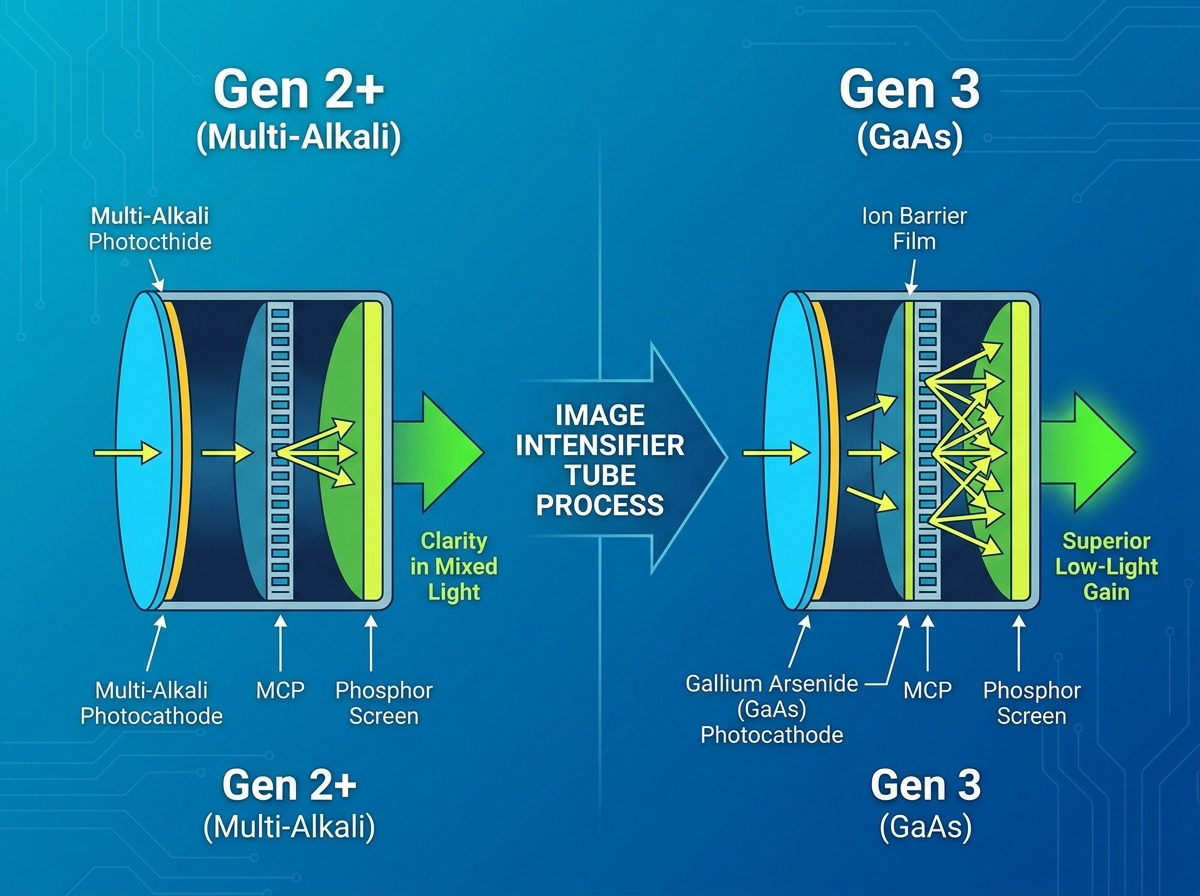
Understanding the hardware inside your device helps you make smarter purchasing decisions. Both generations rely on a photocathode to absorb photons and convert them into electrons. A Microchannel Plate (MCP) then multiplies these electrons before they hit a phosphor screen to create a visible image. The fundamental differences lie in the materials used for the photocathode and the internal architecture of the tube.
Modern Gen 2+ devices rely on advanced multi-alkali photocathodes. You should note "Gen 2+" is not a formal military designation. It is an industry term created to describe highly refined Gen 2 tubes featuring improved Microchannel Plates. Early Gen 2 struggled in deep darkness. However, modern European manufacturers have pushed multi-alkali technology to its physical limits. These upgraded MCPs offer tighter hole pitches, resulting in exceptionally crisp images and excellent light transmission. They represent a massive leap over legacy Gen 2 units.
Gen 3 represents a major shift in material science. Engineers replaced the multi-alkali compound with a Gallium Arsenide (GaAs) photocathode. This specific material exponentially increases photosensitivity. It proves particularly effective in the near-infrared spectrum. A GaAs photocathode converts photons to electrons much more efficiently than multi-alkali variants. This efficiency allows Gen 3 devices to amplify ambient starlight to a degree earlier technologies simply cannot match.
Because GaAs is highly sensitive, it is also fragile. Traditional Gen 3 tubes require a protective ion barrier film on the MCP. This microscopic film prevents positive ions from striking and degrading the photocathode, which would rapidly destroy the tube. However, this protective film slightly impedes the flow of electrons. It reduces image crispness and increases voltage requirements. Modern "filmless" Gen 3 innovations remove this barrier, utilizing auto-gated power supplies to protect the tube while maximizing image sharpness.
Specifications on a manufacturer website only tell half the story. Real-world performance depends heavily on ambient lighting conditions. Selecting the right night vision device requires you to analyze where you will actually operate.
Operating under heavy forest canopy or in remote rural areas presents the toughest challenge for optical gear.
The Gen 3 Advantage: These tubes offer an unmatched Signal-to-Noise Ratio (SNR) in environments featuring zero moonlight or starlight. The high efficiency of the GaAs photocathode pulls in trace amounts of ambient light. This allows you to navigate safely without relying on active infrared illumination.
The Gen 2+ Limitation: When starved of ambient light, multi-alkali tubes struggle. You will notice increased scintillation. Scintillation looks like visual noise or TV "snow" dancing across your image. This static degrades image resolution and makes identifying distant targets difficult.
City environments are rarely completely dark. Streetlights, headlights, and building lights create a chaotic, dynamic lighting environment.
The Gen 2+ Advantage: Top-tier Gen 2+ tubes handle dynamic lighting brilliantly. They feature excellent autogating capabilities. You will experience much smaller halo effects around bright light sources. This makes Gen 2+ ideal for law enforcement or urban tactical scenarios.
The Gen 3 Reality: The extreme photosensitivity of GaAs becomes a liability here. Bright urban lights can cause excessive blooming or large halos in Gen 3 devices. Unless equipped with high-end, rapid autogated power supplies, Gen 3 can overwhelm your vision in mixed-light areas.
Theoretical lifespan directly impacts your investment. Gen 3 tubes typically boast a lifespan exceeding 10,000 hours. Gen 2+ tubes generally range between 5,000 and 10,000 hours. While a 5,000-hour gap sounds drastic on paper, you must contextualize it for actual field use.
To exhaust a 5,000-hour Gen 2+ tube, you would need to use your gear for four hours a night, every single night, for over three years. For recreational users, hunters, and enthusiasts, 5,000 hours equates to decades of standard weekend use. You will likely upgrade your housing or face physical damage to the unit long before you exhaust the phosphor screen.
Generational labels serve as broad categories. To truly assess performance, you must look at individual unit specifications. Two tubes from the same production batch can perform vastly differently. Always evaluate the following core metrics.
Metric Name | What It Measures | Why It Matters in the Field |
|---|---|---|
Signal-to-Noise Ratio (SNR) | Ratio of clean image signal versus background electronic noise. | Dictates low-light performance. Higher SNR means less static ("snow") in deep darkness. |
Resolution (lp/mm) | Line pairs per millimeter. Measures optical clarity. | Dictates image sharpness. Allows you to see fine details like facial features or wire fences. |
Figure of Merit (FOM) | Calculated by multiplying SNR by Resolution. | Provides a standardized baseline for comparing overall tube performance across any generation. |
Consider SNR the most critical metric for low-light performance. The higher the number, the cleaner the image. A high SNR means less static obscuring your view. If you prioritize deep-woods navigation, you must demand a high SNR above all other metrics.
Resolution dictates the sharpness of your image. A higher number translates to a crisper picture. You should note top-tier Gen 2+ models can easily match or exceed baseline Gen 3 resolution. High-end Gen 2+ tubes frequently hit 64 to 72 lp/mm, offering incredible detail recognition.
FOM acts as the universal benchmark. It combines SNR and Resolution (SNR x Resolution = FOM). Military and export regulations often use FOM to classify device capabilities. Using FOM allows you to evaluate any night vision unit objectively, regardless of its generational label.
A common mistake buyers make is purchasing based solely on the "Gen 3" label. Always demand individual tube data sheets before purchasing. A premium Gen 2+ unit boasting a 2000+ FOM will visually outperform a minimum-spec, blemished Gen 3 unit with a 1400 FOM. The numbers on the data sheet never lie.
Ask the dealer for the exact spec sheet of the tube you are buying.
Check the SNR first. Ensure it meets your low-light requirements.
Check the spot chart. Note any factory blemishes in Zone 1 (the center of your vision).
Compare the FOM against other tubes in your price bracket.
Matching your hardware to your specific mission profile guarantees you do not overspend on unnecessary capabilities.
For professional aviation, military, and high-threat tactical operations, Gen 3 (or Gen 3+) remains the mandatory standard. Aviation requires stringent mil-spec compliance. Pilots need extreme edge-to-edge clarity and supreme low-light survivability to avoid spatial disorientation. The GaAs photocathode ensures maximum detection range. When lives depend on seeing hazards in absolute darkness, Gen 3 provides necessary peace of mind.
Astronomers frequently debate the merits of high-end Gen 2+ versus Gen 3. Observing the night sky requires high photosensitivity and low halo effects. Most serious stargazers lean heavily toward Gen 3. The near-infrared sensitivity of GaAs excels at picking up deep-sky objects and nebulas, especially when paired with H-alpha filters. However, premium Gen 2+ tubes remain viable for casual backyard astronomy.
For recreational pursuits, Gen 2+ stands out as the most pragmatic choice. If you hunt feral hogs, you often operate under moonlight. If you play airsoft, you likely use active IR illuminators. The presence of moonlight or artificial infrared light completely nullifies the primary low-light advantage of Gen 3. A premium Gen 2+ tube handles these scenarios perfectly while saving you substantial capital. You can redirect those funds toward better mounts, helmets, or thermal overlays.
Decision paralysis hits many buyers when viewing dozens of similar models. You can simplify your decision by following a straightforward logic matrix based on budget and environment.
Your budget comfortably exceeds $3,500 per tube.
Your primary use involves passive aiming in remote, rural areas featuring heavy canopy cover.
You require gear for professional duty use where maximum detection range acts as a life-safety requirement.
You prioritize extreme low-light performance over saving money.
Your budget is strictly constrained between $2,000 and $2,500.
Your operations primarily occur in urban or suburban environments with high ambient light.
You intend to actively use IR illuminators or IR lasers. Active illumination levels the playing field between generations.
You want the cleanest possible image without overpaying for mil-spec zero-light capabilities you will rarely use.
Purchasing optical gear represents a significant investment. You must approach the process strategically. Focus on the actual performance metrics rather than getting caught up in generational marketing hype. Evaluate your primary operating environment honestly.
We strongly recommend you do not buy a low-grade Gen 3 unit simply for the badge. A premium Gen 2+ model, such as a Photonis Echo, will yield a cleaner, more reliable image than a heavily blemished, low-spec Gen 3 tube. It handles high-light environments better and offers exceptional clarity for most recreational applications.
Your next step is simple. Reach out to a reputable dealer. Ask to review actual tube data sheets. Compare the FOM and SNR numbers side-by-side. By matching specific data points to your operational environment, you ensure optimal performance and maximum satisfaction in the field.
A: Yes. Both Gen 2+ and Gen 3 systems are available in Green Phosphor and White Phosphor. The phosphor color is entirely independent of the generation. White Phosphor often reduces eye strain and improves contrast, making it popular across all modern tube generations.
A: Yes. All Gen 2+ and Gen 3 devices can see IR lasers and illuminators. They both pick up active infrared light exceptionally well. However, Gen 3 is inherently more sensitive to the near-IR spectrum, allowing it to gather ambient starlight more effectively.
A: Rarely. Unless a beginner operates exclusively in zero-light rural environments without an IR illuminator, Gen 2+ provides a highly capable, cost-effective entry point. It offers excellent resolution and durability, saving money that beginners can spend on helmets, mounts, and training.


