
Language
Views: 0 Author: Site Editor Publish Time: 2026-07-03 Origin: Site


Procuring optical equipment stands as a high-stakes capital investment for any organization. The stark difference between adequate visibility and complete situational dominance relies heavily on accurately matching tube specifications to actual operational environments. Buyers often overpay for advanced capabilities they do not practically need. Alternatively, they severely under-spec gear for mission-critical deployments. They make these errors because they misunderstand the baseline differences across generation tiers and hybrid technologies. This comprehensive guide strips away the marketing ambiguity surrounding optical devices. We evaluate the actual implementation realities, strict performance benchmarks, and specific acquisition risks across Gen2+, Gen3, and Thermal Fusion systems. You will discover exactly how to align internal technology requirements with your operational theater. We provide the technical clarity required to make informed, highly effective procurement decisions for your teams without compromising safety.
Performance is tied to the tube: The core differentiator in standard night vision is the image intensifier tube, dictating resolution, lifespan, and low-light capability.
Gen2+ vs. Gen3 comes down to ambient light and budget: Gen3 offers superior signal-to-noise ratio (SNR) in near-zero light due to its Gallium Arsenide (GaAs) photocathode, but high-end Gen2+ provides a viable, cost-effective alternative for environments with moderate ambient light (urban/suburban).
Thermal fusion eliminates the camouflage gap: While traditional night vision requires ambient light and struggles with obscured targets, thermal fusion overlays heat signatures to guarantee detection regardless of lighting or foliage.
FOM isn't everything: Decision-makers must weigh Figure of Merit (FOM) against tube blemishes, autogating capabilities, and warranty constraints before acquisition.
Understanding the technical baseline remains crucial before evaluating specific generations. The core component defining device capability is the image intensifier tube. This intricate internal cylinder actively collects available ambient photons through an objective lens. Once collected, a Microchannel Plate (MCP) multiplies these tiny light particles exponentially. The MCP functions as a microscopic honeycomb structure set at a slight angle. The multiplied electrons then crash violently into a specialized phosphor screen. This collision translates invisible energy into a bright, visible image for the operator.
Professionals evaluate these tubes across several critical dimensions. You must connect raw technical specifications to real-world operational outcomes.
Resolution (lp/mm): This metric determines overall image sharpness. High resolution directly impacts your maximum target identification distance. It allows you to distinguish a weapon from a benign object at considerable range.
Signal-to-Noise Ratio (SNR): SNR serves as the true indicator of low-light performance. A higher SNR means you experience far less visual "snow" or scintillation in heavily darkened environments.
Figure of Merit (FOM): The industry relies heavily on this standard metric. Manufacturers calculate it by multiplying Resolution by SNR. It proves highly useful for baseline shortlisting and strict export compliance assessment.
Higher FOM broadly correlates to better visual performance. However, you must recognize a transparent assumption here. Marginal gains above a 2000 FOM rating often yield rapidly diminishing returns for non-specialized users. The human eye simply struggles to perceive slight resolution upgrades beyond a certain threshold during dynamic movement.
Specification Dimension | Primary Operational Impact | Common Baseline Target |
|---|---|---|
Resolution | Detail clarity and target ID | 64 lp/mm to 72 lp/mm |
Signal-to-Noise Ratio | Low-light visual clarity | 20 to 30+ |
Figure of Merit | Overall tier classification | 1400 to 2200+ |
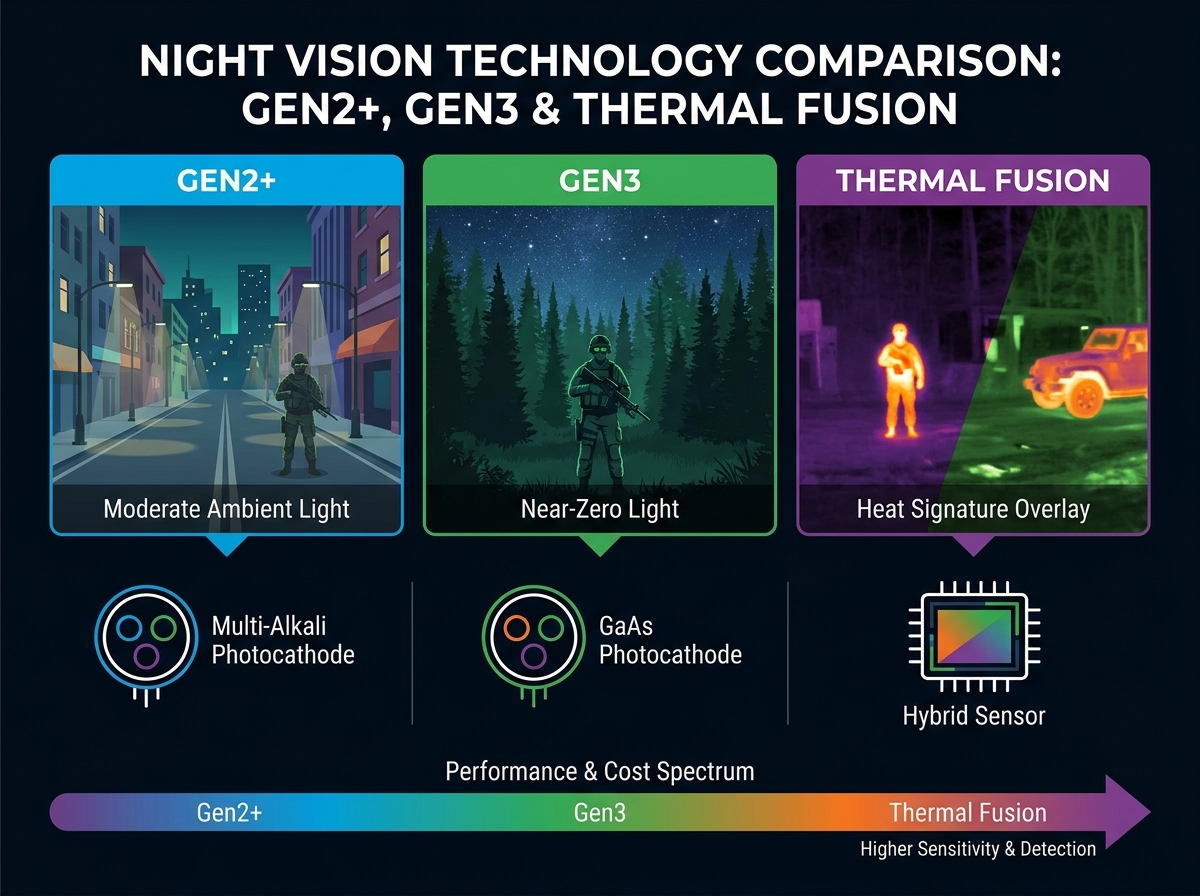
Choosing between Gen2+ and Gen3 requires balancing acquisition constraints against the absolute minimum lighting requirements of your intended operational theater. Teams cannot simply purchase the highest specification without thoroughly analyzing the deployment environment.
The Gen2+ tech shift centers around the integration of a Multi-Alkali photocathode. This material effectively gathers light across specific wavelengths to produce a reliable image.
Strengths: This category delivers significant capital savings compared to higher tiers. Operators find it highly effective in urban environments. Suburban areas featuring high moonlight or abundant artificial light also suit it perfectly. Additionally, it remains far less susceptible to stringent ITAR export restrictions. This dramatically simplifies international logistics and deployment timelines.
Implementation Reality: Operators face notable challenges in heavy canopy foliage. Deep rural environments lacking ambient moonlight reveal its limitations quickly. Without supplemental infrared (IR) illumination, a Gen2+ device struggles to provide clear navigational imaging in these severe, light-deprived conditions.
Gen3 introduces a major technological shift via the Gallium Arsenide (GaAs) photocathode paired alongside an ion barrier film. This specific combination vastly increases photon sensitivity and tube durability.
Strengths: Gen3 offers exponentially higher light sensitivity. The tube lifespan extends dramatically, often exceeding 10,000 hours of active use. Operators achieve vastly superior performance in passive, zero-illumination environments. It dominates deep woods, caves, and completely overcast nights where Gen2+ falters.
Implementation Reality: Buyers face a very steep barrier to entry regarding initial procurement. Gen3 devices remain strictly subject to ITAR regulations. Availability constraints frequently delay deployment timelines for non-military agencies trying to source premium tubes.
Hybrid optical systems represent a monumental leap in situational awareness. These complex devices work by seamlessly overlaying thermal imaging directly onto analog night vision displays.
The Operational Deficit of Analog: Traditional setups possess inherent vulnerabilities. They fail entirely against static, well-camouflaged targets blending into the background foliage. Ambient smoke, thick fog, or absolute zero-light environments easily defeat standard analog sensors. Subterranean operations highlight these critical flaws dramatically, often leaving operators effectively blind without active IR output.
The Fusion Advantage: This technological solution effectively combines the navigational ease of analog optics with absolute thermal detection. Operators gain positive target identification (PID) through the crystal-clear analog feed. Simultaneously, the thermal sensor highlights hidden body heat. Many fusion systems offer multiple viewing modes, such as outline mode or full thermal overlay, granting unmatched adaptability.
Implementation Risk:
Increased physical weight on the helmet system causes quicker neck fatigue.
Significantly shorter battery life compared to standalone analog units necessitates strict power management.
High cognitive load for the operator during intense, high-stress situations.
Requires specific, intensive training to safely process dual data streams without experiencing sensory overload.
Hardware specifications mean absolutely nothing if they fail to align with the mission profile. You must categorize your operational needs accurately to avoid critical deployment failures.
Requirement: Urban tactical teams absolutely require Positive Target Identification (PID). They constantly conduct dynamic entries under rapidly shifting lighting conditions.
Recommendation: Deploy Gen3 systems, specifically utilizing white phosphor, or implement full Thermal Fusion. White phosphor provides a much more natural contrast spectrum for the human eye, reducing strain during long standoffs. You must ensure autogating is mandatory. This vital feature handles sudden, intense flashes from muzzle devices or shifting urban lighting without temporarily blinding the operator.
Requirement: Users demand reliable mid-to-long range detection. They generally operate in highly predictable outdoor environments.
Recommendation: A high-spec Gen2+ or an entry-level Gen3 unit fits this profile perfectly. Supplemental IR illuminators efficiently bridge the performance gap of Gen2+ in these specific scenarios. When scanning massive fields, the extreme low-light sensitivity of premium Gen3 might not be strictly necessary if you can deploy active IR safely without compromising your position.
A standard pair of night vision goggles never operates in a vacuum. You must carefully assess the total system weight placed upon the operator's neck. Professional solutions demand dedicated tactical helmets. You cannot simply strap expensive devices to inadequate headgear. They require reinforced shrouds, perfectly balanced counterweights, and highly specific mounting hardware. Precision systems like Wilcox mounts guarantee stability during rapid movement. Without proper physical integration, even the absolute best optical devices become a severe physical liability.
Evaluating hardware involves navigating severe acquisition risks. You must look far beyond the basic marketing numbers to secure dependable equipment.
Quality Control & Blemishes: Buyers must thoroughly understand and evaluate "zone blemishes." These appear as permanent dark spots inside the tube caused by manufacturing imperfections. Manufacturers divide the circular viewing area into three concentric zones. Zone 1 sits precisely in the center of your vision. A cheaper Gen3 tube might feature highly distracting Zone 1 blemishes. These heavily block critical target details. Consequently, a pristine Gen2+ tube boasting zero center blemishes often represents a much better operational choice than a flawed Gen3 unit.
Lifespan & Maintenance: Gen3 tubes generally outlast Gen2+ alternatives by several thousand operational hours. This heavily impacts long-term replacement cycles for active departments. However, all optical devices require meticulous maintenance. You must store them properly, away from extreme humidity and direct sunlight. Agencies must establish strict protocols for battery removal to prevent corrosive leaks from destroying expensive internal electronics.
Next-Step Actions: Establish clear, uncompromising vendor evaluation criteria. Demand comprehensive spec sheets displaying exact SNR and resolution numbers for your specific tube, not just aggregate batch numbers. Verify autogating capabilities thoroughly. Confirm all warranty terms before issuing large purchase orders. You should aggressively vet any supplier of night vision to guarantee mission readiness upon delivery.
Night vision procurement should always be driven by environmental light baselines and mission criticality. You cannot base critical decisions purely on the "generation" label printed on the box. Gen 2+ serves as the highly pragmatic choice for budget-aware scalability. Gen 3 remains the definitive standard for austere environments. Thermal Fusion stands as the undisputed pinnacle for uncompromised detection.
Review your specific operational mandates closely. Assess the ambient lighting of your typical deployment zones meticulously. We encourage you to review specific product catalogs or request a detailed quote. Consult with a technical sales team to conduct a custom capability assessment for your exact organizational needs. Taking these deliberate steps ensures your teams operate with total dominance in the dark.
A: Yes, but this difference primarily reveals itself in extreme low-light scenarios. If you operate under a heavy tree canopy or on moonless nights, Gen3 clearly dominates. However, in urban settings featuring ambient light, the performance gap between them narrows significantly.
A: White phosphor generally reduces eye strain during extended use. It provides much better natural contrast recognition for most operators. This makes it the current tactical preference, even though it typically comes at a higher price premium over traditional green phosphor.
A: No. Analog systems actively require some ambient light, such as stars or moonlight, to function properly. In absolute zero light conditions, like caves or windowless rooms, operators must use IR illuminators or switch entirely to thermal detection devices.
A: Autogating is a critical power-supply feature. It rapidly cycles power to the internal tube. This mechanism actively protects the device from sudden, bright light exposure, such as incoming headlights or flashbangs, while simultaneously maintaining a clear image resolution for the user.


