
Language
Views: 0 Author: Site Editor Publish Time: 2026-03-25 Origin: Site


Investing in night vision is a high-stakes decision, where the term "better" is entirely subjective to your mission, environment, and budget. It's a significant financial commitment, and the choice between a single-tube monocular and a dual-tube binocular can define your effectiveness in the dark. The technology has evolved dramatically from early single-tube systems into the sophisticated dual-tube Night Vision Goggles we see today. However, more tubes do not always mean a better outcome. This guide moves beyond basic specifications to help you evaluate these systems based on real-world operational performance, ensuring your investment aligns perfectly with your needs.
Quality over Quantity: A high-spec monocular night vision unit (e.g., L3Harris Gen 3) often outperforms a budget-tier binocular system.
Depth Perception Myth: While binocular night vision offers true stereoscopic vision, experienced users can navigate effectively with monoculars using "monocular cues."
Weight & Fatigue: Binoculars provide better immersion but double the weight, requiring aggressive counterweighting and increasing neck strain.
Versatility: Monoculars offer superior integration with thermal optics and weapon-mounted applications.
Before comparing housings, you must understand the engine that drives them. The performance of any night vision device is dictated by its Image Intensifier Tube (IIT). This core component is what amplifies ambient light, and its quality is far more important than whether you have one or two of them. The choice between a monocular and a binocular is secondary to the quality of the tube inside.
The IIT is the heart of analog night vision. Leading manufacturers like L3Harris, Elbit Systems, and Photonis produce tubes with varying specifications that determine image clarity, brightness, and performance in near-total darkness. Key metrics to look for include:
Figure of Merit (FOM): A general score calculated by multiplying the tube's resolution (lp/mm) by its Signal-to-Noise Ratio (SNR). Higher FOM generally indicates better performance.
Signal-to-Noise Ratio (SNR): This is arguably the most critical spec. It measures the "cleanliness" of the image. A high SNR provides a clear, sharp image with less "scintillation" or static in very low light conditions.
Resolution (lp/mm): Measured in line pairs per millimeter, this indicates the tube's ability to resolve fine details.
A high-end Gen 3 tube from L3Harris in a monocular housing will always provide a more usable image than two lower-spec Gen 2 tubes in a binocular housing. This is the foundation of the "quality over quantity" principle.
The PVS-14 monocular has been an industry standard for decades for good reason. Its single-tube design offers unmatched versatility. The primary advantage is maintaining "situational awareness" by keeping one eye adapted to ambient light. This allows you to instantly gauge light conditions, read illuminated displays, or transition into a high-light environment without being completely disoriented. Your unaided eye helps process shadows and light sources that are invisible through the IIT, giving your brain more information to build a complete picture of your surroundings.
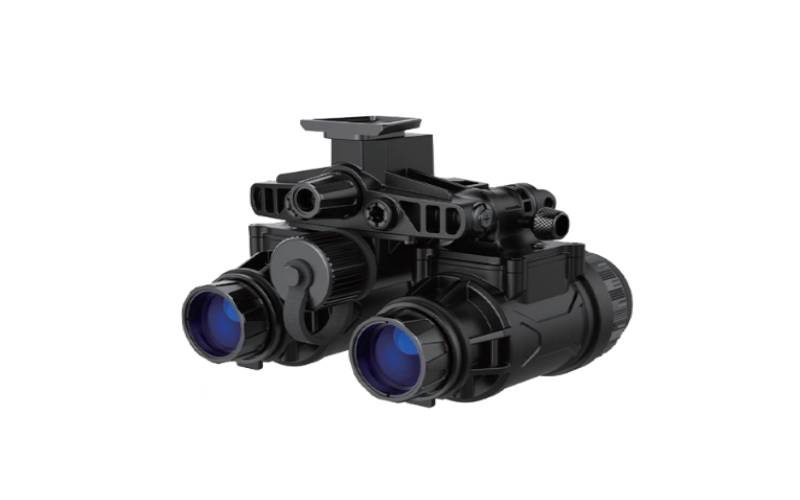
Dedicated binocular night vision devices (BNVDs) use two separate IITs, one for each eye. This provides true stereoscopic vision, which is how your brain naturally perceives the world. This design significantly reduces the "soda straw" effect, where looking through a single tube can feel restrictive. By feeding both eyes a clear, intensified image, binoculars reduce brain fatigue over long periods. Your mind doesn't have to work as hard to reconcile two different inputs (one aided, one unaided), making for a more immersive and comfortable experience, especially during movement.
Two critical features of modern Image Intensifier Night Vision are manual gain and auto-gating.
Manual Gain: This allows you to manually adjust the brightness of the IIT. In urban environments with lots of ambient light, you can turn the gain down to reduce noise and protect the tube. In the wilderness, you can turn it up to maximize light amplification.
Auto-Gating: This feature rapidly cycles the tube's power on and off to protect it from sudden bright light sources, like muzzle flashes or streetlights. It prevents the image from "blooming" out and preserves your view of the target area.
These technical capabilities are crucial for users operating in dynamic lighting conditions and are often found in high-quality tubes, regardless of the housing they are in.
How a device performs in the real world goes beyond its spec sheet. The debate between monoculars and binoculars often centers on depth perception, field of view, and overall awareness. These factors directly impact your ability to navigate, identify threats, and operate effectively.
Binoculars provide true stereoscopic vision, which gives users an immediate and intuitive sense of depth. This creates a "confidence gap" for new users. When driving a vehicle or navigating treacherous terrain at speed, the natural depth perception from binoculars is a significant safety and performance advantage. However, the idea that monocular users have no depth perception is a myth.
With practice, the brain learns to use "monocular cues" to judge distance and depth. These cues include object size, light and shadow, and motion parallax (how objects move relative to each other as you move). An experienced monocular user can perform complex tasks with high proficiency, but there is a definite learning curve that binocular users get to bypass.
Both standard monoculars and binoculars typically offer the same 40-degree field of view per tube. So, why do binoculars feel so much wider and more immersive? The answer is a phenomenon called "binocular summation." When your brain receives a coherent image from both eyes, it combines them to create a perceived view that feels more expansive and natural. While you aren't technically seeing a wider area, the quality of the information you receive makes it feel less like looking through a tube and more like seeing with your own eyes.
This is a major point of contention and depends heavily on your mission.
Binoculars for Immersion: Dual tubes provide total immersion in the night environment. Everything you see is amplified, which is excellent for spotting targets in a uniform field of view. However, you are "stuck" in that world and lose touch with ambient light conditions.
Monoculars for Information: A monocular keeps one eye free and adapted to the dark. This unaided eye can pick up information the IIT cannot, such as the faint glow of an LED, the glint off a surface from a distant light source, or subtle changes in shadow that indicate movement. This dual-input method can provide a more complete picture of the environment, which is critical for tactical situations.
The ability to quickly transition between tasks is crucial. A monocular user can simply glance down with their unaided eye to check a map, use a phone, or scan an area with a thermal device without needing to flip the NVG up and out of the way. This seamless transition is more difficult with binoculars, which typically require you to stow the entire unit on your helmet to use your natural vision or other optics. This makes a monocular setup more fluid for tasks that require frequent interaction with illuminated equipment.
Every piece of gear you mount on your head has a cost paid in fatigue. The physical differences between monocular and binocular systems have a profound impact on long-term comfort and usability, especially during extended operations.
On a helmet, the old infantry adage "ounces are pounds, and pounds are pain" is especially true. The weight difference between the two systems is substantial:
Monocular (e.g., PVS-14): Typically weighs 9–12 ounces (255–340 grams).
Binoculars (e.g., DTNVS, RNVG): Often weigh 17–24 ounces (480–680 grams), essentially double the weight.
This extra weight acts as a lever on your neck, and the fatigue it causes compounds over time. While it may not be noticeable in the first hour, it becomes a significant factor after six, eight, or twelve hours of continuous use.
To manage the front-heavy nature of night vision goggles, a counterweight is essential for stability and comfort. Because binoculars are significantly heavier, they require a much more aggressive counterweight solution. This adds even more total weight to your headborne system. A fully kitted helmet with dual tubes, a mount, and counterweights can easily exceed 5 pounds. Over multiple nights of use, this sustained load can lead to chronic neck strain and degrade physical performance.
A monocular is beautifully simple. It has one objective lens to focus for distance and one diopter to focus for your eye. You can typically "set and forget" it. Binoculars, however, require more initial setup. You must adjust:
The objective lens on each tube.
The diopter on each tube to match each of your eyes.
The interpupillary distance (IPD) to align the tubes perfectly with your pupils.
If any of these are misaligned, especially the IPD, it can cause eye strain and headaches. While this is a one-time setup for most users, it's an added layer of complexity compared to the plug-and-play nature of a monocular.
How the device sits on your helmet when not in use matters. Articulating binoculars, which allow each pod to swivel up and out to the sides, offer a lower profile than a monocular flipped up on a standard J-arm. This can reduce the "snag hazard" when moving through doorways or dense vegetation. However, a bridged setup with two monoculars can be even more cumbersome. The simple, compact nature of a single stowed monocular remains a benefit for overall system simplicity.
A night vision device rarely works in isolation. Its ability to integrate with other tools, like firearms and thermal optics, is a critical factor in its overall utility. Here, monoculars often have a distinct advantage.
One of the defining features of a standard monocular like the PVS-14 is that it is often recoil-rated. This means you can detach it from your helmet and mount it behind a red dot sight on your rifle, creating a passive night vision aiming system. This flexibility is invaluable if your helmet mount breaks or if you need to hand the device to a teammate. Most dedicated binocular systems are not designed or rated to withstand weapon recoil and cannot be used in this way.
For users who want the flexibility of monoculars with the experience of binoculars, a bridge mount allows you to connect two individual monoculars. The primary advantage is modularity; you can split the units to share with a partner or run one as a helmet-mounted device and one as a handheld scanner. The major downside is weight. A bridged system is often the heaviest possible setup, exceeding even dedicated binocular units, which can be a deal-breaker for many.
Combining night vision with thermal technology is a game-changer. A monocular setup is ideal for this, allowing you to run the NVG over one eye and a thermal monocular over the other, creating a "fusion" image in your brain. Alternatively, you can keep one eye free to look through a weapon-mounted thermal scope. The physical bulk of binoculars can make it difficult or impossible to get a proper cheek weld and look through a rifle optic, creating an ergonomic conflict that monoculars avoid.
Passive aiming involves looking through your rifle's red dot or holographic sight while wearing your helmet-mounted NVG. Both systems can do this effectively, but it's often easier with a monocular. You can slightly offset the monocular to align with your weapon sight while keeping your other eye open to scan your surroundings. With binoculars, you are completely locked into looking through the optic, which can feel more restrictive.
The adage "buy once, cry once" is gospel in the night vision world. A poor purchasing decision can be both costly and dangerous. When your budget is a primary constraint, the choice between one great tube and two average tubes becomes clear.
This is a common price point for first-time buyers. In this range, you can typically afford a top-tier, high-FOM Gen 3 monocular with excellent performance in all light conditions. Conversely, the same budget might only get you into a set of Gen 2 or low-spec digital binoculars. The high-performance monocular will provide a cleaner, more useful image and be a far safer investment. A grainy, low-SNR image from cheap binoculars is functionally inferior to the crisp image from a quality single tube.
The device itself is just the beginning. Your TCO must include essential support equipment:
Mounts: A quality mount from Wilcox or Norotos is critical for stability and can cost several hundred dollars.
Helmets: A ballistic or bump helmet provides the platform for your system.
Power Packs/Counterweights: These are necessary for balance and extending battery life.
These costs are the same regardless of your device, so allocating your budget to the best possible IIT should be the priority.
The market for high-quality PVS-14 monoculars is incredibly liquid. They are a known quantity, and their components are standardized, making them easy to sell or upgrade. Some proprietary binocular housings have a much smaller secondary market, making it harder to recoup your investment if you decide to change setups later. A high-quality monocular is a safe and durable asset.
Single-tube systems are simpler and more robust. Maintenance is straightforward. Dual-tube systems are more complex. They must be professionally purged with nitrogen to prevent internal fogging and, most importantly, must be collimated. Collimation ensures both tubes are perfectly aligned. If they are not, the user can experience severe eye strain and headaches. This is a specialized service that adds to the long-term cost of owning binoculars.
The right choice depends entirely on your primary mission. There is no single "best" answer, only the best tool for the job. Use this matrix to guide your decision based on your most common applications.
| Use Case | Recommended System | Key Rationale |
|---|---|---|
| Tactical / Law Enforcement | Monocular or High-End Articulating Binoculars | Situational awareness (unaided eye), light weight, and versatility are paramount. High-end binos are an option if budget allows. |
| Predator Hunter | Monocular | Superior for integrating with thermal scopes. Lighter for stalking. Binoculars are a good option for static observation from a blind. |
| Prepared Citizen / Hobbyist | Monocular | Best balance of performance, cost, and versatility. The "cool factor" of duals is outweighed by the practical utility of a high-spec monocular. |
| Driving / High-Speed Navigation | Binoculars | The gold standard. Natural depth perception significantly improves safety, confidence, and reduces cognitive load during depth-sensitive tasks. |
Choosing between monocular and binocular night vision requires a "mission-first" approach. Instead of asking "which is better," ask "which is better for what I do?" The immersion and comfort of binoculars are undeniable, especially for navigation. However, the lightweight, versatile, and cost-effective nature of a high-quality monocular makes it the superior choice for a wider range of users and applications.
If your budget is a limiting factor, the final recommendation is simple: always prioritize the quality of the image intensifier tube over the number of tubes. A crystal-clear image through one eye is infinitely more valuable than a noisy, grainy image through two. To make the best final decision, consult with a specialist who can help match specific tube specs, like SNR and resolution, to the unique lighting conditions of your geographic environment.
A: Yes, you can use a "bridge" mount to connect two monoculars like the PVS-14. This offers great flexibility, as you can split them for individual use. However, this setup is typically heavier and bulkier than a dedicated binocular housing. It also requires careful alignment (collimation) to prevent eye strain, which can be difficult to achieve perfectly without professional tools.
A: When properly collimated, binoculars generally cause less eye strain and mental fatigue over long periods. This is due to "binocular summation," where the brain easily fuses two similar images. A monocular forces your brain to process two very different inputs (one aided, one unaided), which can be tiring for some users initially, though most adapt with practice.
A: For most serious applications, digital night vision is not yet a viable alternative to analog Image Intensifier Night Vision. Digital devices suffer from image lag, have lower light sensitivity, and perform poorly in motion compared to Gen 2+ or Gen 3 IITs. While digital technology is improving, it currently cannot match the performance and reliability of high-quality analog systems.
A: Collimation is the process of aligning the two optical channels in a binocular device so they are perfectly parallel. If the tubes are misaligned, your eyes will try to compensate, pointing in slightly different directions. This leads to eye strain, headaches, and a distorted image. Proper collimation is critical for a comfortable and effective viewing experience, and it requires specialized equipment to set correctly.


